Vanderbilt Health performs nation’s first breast cancer surgery using intraoperative PET-CT scan technology

Submitted by vicc_news on

Following the introduction of a surgical protocol that leveraged intraoperative imaging with a combination PET-CT scanner to assess the success of head and neck cancer resection, surgeons have used the technology for breast cancer.
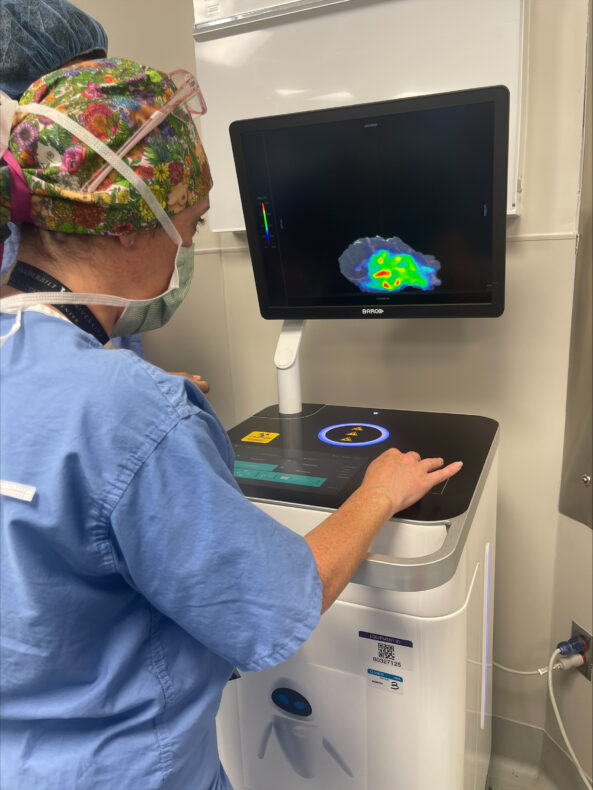
Denise Garcia, MD, uses the Xeos Aura 10 scanner to image a recently excised breast tumor from a patient. The use of the Xeos Aura 10 device ensures the imaging and assessment can be done in the operating room rather than in the pathology lab. (photo by Kyrionna Golliday)

Investigators led by Michael Topf, MD, Associate Professor of Otolaryngology-Head and Neck Surgery, performed the nation’s first surgery using intraoperative PET-CT scanning in September 2025. Now, a surgical team led by Denise Garcia, MD, Assistant Professor of Surgery in the Division of Surgical Oncology and Endocrine Surgery, has applied the technology to successfully resect a breast cancer mass.

“This application of intraoperative PET-CT is proof that countless patients can benefit from the expansion of this novel imaging methodology,” said Garcia. “Our team is proud to apply it to a type of tumor that has not yet been imaged for the purposes of assessing margin status. As our institution expands treatment methodologies to more types of cancer, we can cure more patients and give them peace of mind that their surgery has been completed with precision. This technological advancement underscores the success we’ve had across multiple disciplines in working toward that goal.”

Rapid expansion of intraoperative PET-CT scanning boosts efficiency, offers peace of mind to surgeons and patients alike

With each new application, surgeons are demonstrating that an intraoperative PET-CT imaging protocol can help reduce wait time for results from several days to a matter of minutes and allow surgical teams to know immediately whether they need to continue operating.

During surgery, the patient receives a dose of a radioactive agent that illuminates the cancer tissue in the scanner. Once the tumor is excised, it is placed in a specialized mobile PET-CT scanner called an Aura 10 device, developed and supplied by Belgium-based surgical technology company Xeos. The scanner negates the need to send the specimen to the pathology lab, providing surgical teams with a real-time view and allowing them to quickly determine if the entire cancerous mass was removed.

If any mass remains, the operation continues. If the cancer has been successfully resected, the surgery concludes, and the patient is sent home with peace of mind, knowing they won’t need to return for a follow-up surgery, and with confidence that their surgeons have a precise, immediate look at the results of the surgery. Because patients receive the radioactive agent on the day of surgery rather than in advance, they also receive a lower dose of radiation.

The post Vanderbilt Health performs nation’s first breast cancer surgery using intraoperative PET-CT scan technology appeared first on Vanderbilt Health News.

Grant supports development of head-mounted augmented reality system to guide tumor resection 

Submitted by vicc_news on

In a collaboration between Vanderbilt University Medical Center’s Department of Otolaryngology-Head and Neck Surgery and the Vanderbilt University School of Engineering, investigators have received a $2.5 million grant to develop a head-mounted augmented reality system that can guide surgeons in ensuring complete tumor removal in head and neck cancer surgery and potentially reduce the recurrence rate of tumors. 

The National Institutes of Health grant was awarded to primary investigator Jie Ying Wu, PhD, assistant professor of Computer Science, with secondary appointments in Biomedical Engineering, Electrical and Computer Engineering, and Mechanical Engineering at Vanderbilt University. Wu also has an appointment in the Department of Surgery at Vanderbilt University Medical Center. 

Co-investigators include Michael Miga, PhD, director of the Vanderbilt Institute for Surgery and Engineering and the Harvie Branscomb Professor and chair of the Department of Biomedical Engineering, as well as Michael Topf, MD, associate professor of Otolaryngology-Head and Neck Surgery, and Matthew Weinger, MD, professor of Anesthesiology and Biomedical Informatics. 

“I am delighted to receive this award to transform surgical care for head and neck cancer,” said Wu. “This funding will allow us to build novel deformation models for heterogeneous tissue shrinkage and ensure the augmented reality software design is intuitive for surgeons and fits within the clinical workflow.” 

The development of the technology stems from a deficit Topf noticed in surgical oncology. While three-dimensional scanning has become part of the norm for other aspects of patient care, from same-day dental crowns to prosthetic limbs, Topf was troubled by the lack of application for 3D scanning in oncologic surgery. Topf implemented a protocol to create 3D models of resected cancers for surgeons, pathologists and oncologists to reference. 

“We came up with a way to 3D scan a surgical specimen in real time in less than 10 minutes prior to processing and not interfere with all the other important things that are going on in the pathology lab,” said Topf. “Encouragingly, this is a widely transferable practice and would be applicable to most cancer surgeries, from orthopaedic oncology to breast cancer.” 

Weinger, who is a faculty member of the Center for Research and Innovation in Systems Safety (CRISS) at VUMC, expressed the organization’s eagerness to support the research. 

“CRISS is excited to contribute to this important project, applying advanced engineering to ensure the user interface of this technology guides surgeons to safely and effectively treat cancer patients,” said Weinger, who holds the Norman Ty Smith Chair in Patient Safety and Medical Simulation. 

Safety and effectiveness are at the core of the research. As Miga explained, the 3D mapping technology will allow surgeons to rely less on a fallible mental construction of the resection plane, thereby reducing the risk of human error affecting the procedure. 

“When it comes to cancer surgery, surgeons often say, ‘We think we got it all,’” said Miga. “What many don’t realize is that every operation requires the surgeon to construct a mental spatial map, linking the visible surgical field to their internal understanding of the tumor’s extent. It’s an incredibly complex task, and sometimes, despite best efforts, reoperations are necessary. 

“Now imagine if, while the patient is still on the table, we could detect the margin in real time, and then, using a holographic overlay, highlight the precise region that needs further attention. Through our collaboration, that’s the kind of transformation we’re seeking to make commonplace with this research.” 

Collaboration has been consistent over the last few years between the Medical Center and the University, said Wu. She hopes research into the technology will eventually support a clinical trial, a sentiment shared by Eben Rosenthal, MD, Barry and Amy Baker Professor and chair of the Department of Otolaryngology-Head and Neck Surgery. 

“Improving surgical outcomes is of the utmost importance, especially when it comes to ensuring total tumor removal and reduced risk of recurrence for cancer patients,” said Rosenthal. “The research supported by this grant will help us perfect this technology as we seek practical applications for patient care, including clinical trials and, eventually, everyday use in the operating room.” 

This study is supported by NIH grant R01EB037685. 

The post Grant supports development of head-mounted augmented reality system to guide tumor resection  appeared first on VUMC News.

Subscribe to Michael_Topf