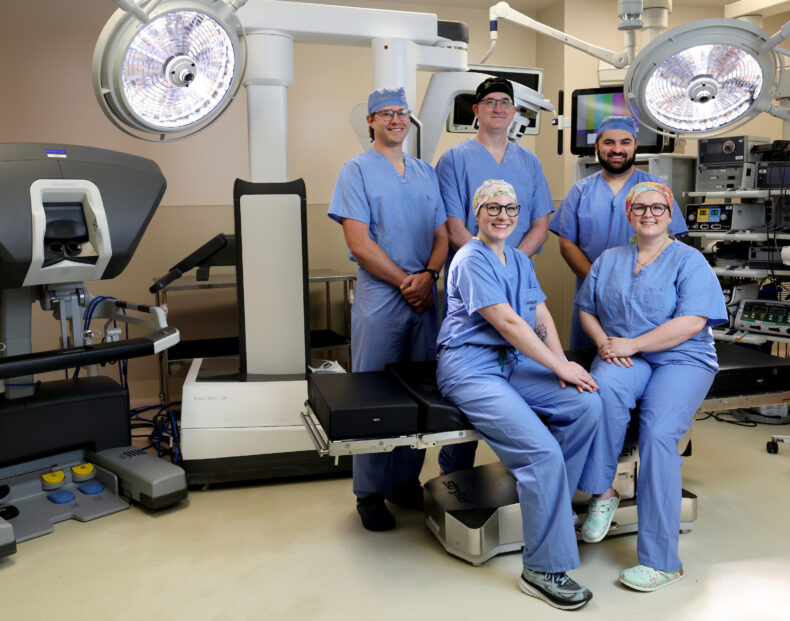
Born to run and be there for his family, Jason Colee underwent a high-stakes spinal surgery so he could do both

Submitted by vicc_news on

Jason Colee, a husband and father of two from Alabama, runs because it refreshes him physically and mentally. In the last three years alone, he has run (and won) multiple 5Ks, several 10Ks, three half-marathons, a 16.2-mile challenge in the Great Smoky Mountains, and even a full marathon.

Notably, just before all these achievements, he underwent a six-hour spine surgery at Vanderbilt University Hospital to remove a rare tumorous mass that was nestled inside his spinal cord.

Colee first noticed problems with his gait, was seen by his orthopedist and tried physical therapy. But after being diagnosed with a myxopapillary ependymoma, Colee’s doctors in Huntsville told him he needed to be seen by the best spine specialists there were.

“Fortunately, we live in North Alabama, and we know Vanderbilt’s got a stellar reputation,” said Colee.

He asked his doctor how soon he should be seen at Vanderbilt Health. “You need to be in there immediately,” was the doctor’s reply.

High risk, high reward

The following week, Colee and his wife, Jennifer, traveled to Vanderbilt-Ingram Cancer Center Belle Meade. He was quickly matched with Scott Zuckerman, MD, MPH, who Colee’s referring physician said would be the best neurosurgeon to handle his case.

“We took it day by day,” said Zuckerman. “We told him it’s a big, high-risk surgery. I couldn’t make any promises about what type of tumor it was or how tightly it was stuck to his spinal cord, but I think he had come to terms with that.”

Colee was admittedly very nervous. But in undergoing the surgery, he gave himself the best shot to preserve his ability to walk, which mattered for two reasons: his love of running and his family.

“There’s a chance that, at some point, you’re going to walk your daughter down the aisle and be there for your grandkids someday, hopefully,” Colee recalled his wife saying. “We’ve got to do this.”

Colee said the “we” mentality Jennifer emphasized helped restore his confidence that the surgery was the right course of action. He credited Jennifer’s resilience and the shared Christian faith of the family — which includes daughter, Emma, and son, Jake — for his ability to withstand the emotional impact of the ordeal.

“The risks were high, but the rewards were high also,” Colee said.

Jason Colee celebrates after completing the Race to Space Marathon, a milestone in the active life he worked hard to regain after wondering whether he would ever walk again.

Nervous about his nervous system, Colee found his care team rose to the occasion

It makes sense that someone headed to anesthesia for spine surgery would be uneasy. Colee’s worry remained despite what he called excellent preoperative care. That’s when Zuckerman came to speak to him.

“This is the A-team,” Zuckerman told Colee. “Everybody you see in this room is the best at what they do.”

On one hand, getting the best of the best may signal that this is as serious as it gets. But on the other, it’s the ultimate assurance that a patient has found the right surgical team.

“The operating room is a serious, focused environment,” Zuckerman said. “But we go into any complex surgery with a really good plan, just like a coach would go into a basketball game with a focused game plan.”

Colee said he never fully conquered his nerves before the surgery.

“Vanderbilt is first-rate,” Colee said. “The process of getting there and everything they did to get me back and ready to go was top-notch; unlike anything we’d ever experienced. It was fantastic.”

Finally, thanks to the anesthesia, his worries subsided as he slipped into sleep. When he awoke, with the tumor out of his spine, he was hit with a wave of relief. Motor function testing showed that everything came back clear.

“I shouldn’t be this excited about being able to wiggle my dang toes,” Colee said. “I guess the gravity of it all hit me after the fact.”

Jason Colee walks his daughter, Emma, down the aisle on her wedding day. Moments like this one were top of mind for Jason and his wife, Jennifer, as they weighed the risks of spinal surgery.

Life after a spinal tumor was just as fulfilling as before

Colee was grateful that his rehabilitation care team wanted input on how he wanted to attack recovery.

“‘We’ve got guidelines we want you to follow and milestones we want you to hit, and it’s up to you how fast you hit those,’” Colee recalled being told. “The nurses let me do what I wanted to do when I wanted to do it as long as it was safe.”

In the end, Colee left the hospital only 48 hours after the conclusion of surgery, a remarkable outcome for a spinal operation.

Soon, Colee wondered when he could get back to running. Zuckerman said if he followed his recovery plan to the letter, it wouldn’t be long.

All told, it ended up only being a six-week hiatus before he put his running shoes on again. It was ugly, Colee said, “like a frog in a frying pan,” but he was moving.

Then came the 5Ks, 10Ks, half-marathons, 16.2-mile race and a full marathon this past spring.

But the most important thing Colee did with his legs didn’t come on the racecourse. It was, as his wife had foreseen, walking his daughter down the aisle.

“Everybody at Vanderbilt was invested in us getting back to where we wanted to be,” Colee said. “This was not guaranteed, even with the surgery. But I knew that Dr. Zuckerman and everybody involved in the process wanted to help me do what I wanted to, whether it was walking my daughter down the aisle or checking a marathon off the bucket list.”

The post Born to run and be there for his family, Jason Colee underwent a high-stakes spinal surgery so he could do both appeared first on Vanderbilt Health News.

Macon County father’s voice restored following oral cancer surgery

Submitted by vicc_news on

Eating, speaking clearly and breathing easily are essential functions we often take for granted, and Nick Schrock of Macon County, Tennessee, admits he did, too. Then, he noticed a small bump inside his mouth that changed everything.  

He was just 30 when he felt a solid bump on the roof of his mouth where the hard and soft palates meet. It didn’t hurt and wasn’t irritated, so Schrock dismissed it as a random nodule of bone he just hadn’t noticed before. Nine months later, however, it began to grow and was soon the size of a quarter and felt “rubbery” rather than hard.  

“It started to hurt when I yawned or took a bite of food,” he said. “It got bothersome, and I told my wife I needed to have it looked at.” 

Today, after recovering from surgery at Vanderbilt University Hospital to remove what turned out to be a cancerous tumor and radiation therapy to target any remaining cancer cells, Schrock is grateful for all the care he’s received, but especially to have his voice back. Because of this, he feels he can be a better parent to his young daughter, Magnolia Mae, and can enjoy life with his wife, Brittany, and other family and friends. 

After the tumor removal left a sizable hole inside his mouth, he initially could only speak in a muffled, lispy whisper. This was due to velopharyngeal insufficiency, a condition where the seal between the oral and nasal cavities does not close completely. 

Schrock credits Vanderbilt University Medical Center providers for not only quickly addressing his cancer but also for restoring his voice. A key player on that collaborative team is Tyler Ames, DMD, chief of the Division of Dentistry at VUMC.

A custom obturator designed by VUMC’s Tyler Ames, DMD, sealed the hole left after removal of an oral cancer and restored Nick Schrock’s voice. It fits along the roof of the mouth, and the ball seals the cavity. (photo by Susan Urmy)

A rare cancer and arduous treatment  

In January 2024, a biopsy revealed adenoid cystic carcinoma (ACC), a rare cancer typically originating in the salivary glands that makes up about 1% of all head and neck cancers. This type of cancer doesn’t run in families, and there are no known risk factors. While ACC is slow growing, it is aggressive. Surgery is the primary treatment, often followed by radiation. Reconstruction or prosthetics are often needed following treatment. 

Because of the intricate anatomy of these areas of the body and often delayed detection, treatment for head and neck cancers can be arduous and impact critical functions like speaking, breathing and swallowing. 

Within a week, the Schrocks were consulting with Alexander Langerman, MD, SM, a head and neck cancer and reconstructive surgeon at VUMC with fellowship training in microvascular reconstruction. Surgery was quickly scheduled. 

Langerman worked for five hours to remove a golf-ball sized growth that was extensively invading the soft tissue and muscle, especially muscles involved with chewing. It required removal of part of Schrock’s upper jawbone and a few teeth. Langerman then performed a local flap surgery using part of Schrock’s inner cheek to help patch the hole inside his mouth.  

Schrock then underwent radiation therapy under the care of D. Nathan Kim, MD, PhD, a Vanderbilt Health radiation oncologist at Vanderbilt-Ingram Cancer Center at Wilson County, which was much closer to his home.  

Making it through 33 sessions of radiation treatment was one of the hardest things he’s ever done in his life, Schrock said. His mouth and throat were raw and dry. His stomach was continually upset. His hair, including his beard, fell out. And he lost 60 pounds.  

And there were other setbacks. He lost hearing in his right ear because of a fluid buildup due to the radiation. That was resolved quickly through a minor procedure by otolaryngology-head and neck surgeon Matthew O’Malley, MD. Schrock also began having difficulty breathing through his nose. Another otolaryngology-head and neck surgeon, Naweed Chowdhury, MD, MPH, cleared swollen tissue caused by the radiation from a maxillary sinus, which improved his ability to breathe. 

But the biggest thing he wanted resolved was his voice. Ames was ready. He had been in consultation with Langerman from the start of Schrock’s journey, viewing imaging and following his progress closely.  

“Nick expressed that he was afraid of his daughter being embarrassed by his speech,” Ames said. “I took this to heart as I also have a young daughter. Putting myself in his shoes, I knew that I had to do everything I could to help him. 

“With these cases you really are not sure what is possible until you try. Nick is an amazing patient who is very motivated. His drive helped to keep the treatment on track and helped motivate me to do the best I could for him.” 

Prosthetics to seal oral cavity holes

When individuals are left with holes or deficits in their oral cavity due to congenital defects like cleft palate, cancer surgeries or trauma, prosthetics known as obturators are often custom designed to restore function. This is what Schrock needed.  

“An obturator is a prosthetic device used to close and seal a defect or opening in the hard or soft palate to assist in speech and eating and drinking,” Ames said. “This can prove challenging because you are not always sure if the patient is going to tolerate having the obturator in the back of their throat.” 

Because of the precision diagnoses and effective treatments provided by Vanderbilt-Ingram clinicians, patients come not just from Tennessee but also from parts of seven contiguous states and beyond. That means the center sees a higher volume and higher complexity of patients with head and neck cancers. Ames was increasingly being referred individuals who needed restoration after surgery.  

Obturators are usually created by specialized dentists known as prosthodontists or maxillofacial prosthodontists, but many private practices instead focus on dental implants and other higher volume, profitable procedures. Finding a dentist who can create a custom obturator isn’t easy. With the growing number of cancer patients he was seeing with unique needs, Ames decided a few years ago he would research and teach himself the precision craft of creating obturators.  

“Since Tyler joined VUMC, we have worked together in tougher and tougher cases and grown together as partners,” Langerman said. “Nick’s case was indeed a tough one, and his success is the product of the years of work Tyler has put in to restore patients to a greater quality of life after surgeries such as this.” 

Ames works with Vanderbilt Health surgical oncologists to review imaging, even running over to the surgical clinics so he can see the space he needs to seal. He works with an area dental lab to produce obturator prototypes and in the early days, he even tried varied materials to achieve the best seals and most comfortable devices. Now, though every case is different, he has become adept at problem-solving and creating obturators for even highly complex cases.  

“In Nick’s case, a nasal endoscopy performed by Dr. Langerman with the custom obturator in allowed me to have a ‘GPS’ to show exactly where I needed to add to the obturator to better seal the defect and aid his speech,” Ames said. “We could see the obturator in place from the viewpoint of the sinus, which helped tremendously.” 

Recently, Ames met with Schrock again and checked in on his progress. His voice was strong and easily understandable. But Ames cocked his head, listened closely, and told Schrock he felt like he could make some minor adjustments to improve his voice even more. Schrock smiled. 

“Dr. Ames has significantly changed my life,” Schrock said. “I still struggle, and I don’t like talking in front of a lot of people, but what he’s done for me is incredible.  

“I don’t mind sharing my story if it gives someone else hope. It does get better. I didn’t feel that way for a while, but it does.”

The post Macon County father’s voice restored following oral cancer surgery appeared first on VUMC News.

The real MVP: Fitness challenge raises funds in honor of 4-year-old cancer patient

Submitted by vicc_news on

When 4-year-old Monroe Peterson was diagnosed with cancer, her family was determined to not only rally around her in support but also wanted to make a difference for other patients and families going through a similar experience.

To honor her journey, in November 2024 Monroe’s father, fitness expert and celebrity trainer Gunnar Peterson, started the MVP Challenge on his app, Common Ground, to raise awareness and funds for pediatric cancer efforts at Monroe Carell Jr. Children’s Hospital at Vanderbilt.

The MVP Challenge, named for Monroe Vivian Peterson, included four weeks of guided workouts, question and answer sessions with Gunnar, and an opportunity to win special prizes. The fitness challenge raised funds to support pediatric cancer research, training and care at Monroe Carell.

“For months, Monroe has faced this battle with more grit, determination and positivity than I’ve ever seen,” said Peterson. “She hasn’t backed down; she doesn’t quit; and she moves forward with a smile on her face every day. To honor her strength, we launched the MVP Challenge as a way to come together as a community, push ourselves and raise funds to support children’s cancer treatment and research.”

Monroe Peterson with her mother, Jessica, left, and Debra Friedman, MD, MS.

Monroe was diagnosed with acute myeloid leukemia and completed two rounds of chemotherapy. She received two bone marrow transplants, one from each of her older brothers, and she is now in remission.

During her treatment, Monroe’s family says that she brought positivity, joy and levity to those around her and earned the nickname MVP. Many family members, friends and community members came together in support of the challenge to make it a success.

“We are blown away by the incredible success of the MVP Challenge and know that it would not have been possible without the advocacy, outreach and community engagement work of Gunnar, Jess and the whole Peterson family,” said Debra Friedman, MD, MS, director of the Division of Pediatric Hematology and Oncology at Monroe Carell, deputy director of Vanderbilt-Ingram Cancer Center, and holder of the E. Bronson Ingram Chair in Pediatric Oncology. “This challenge was a wonderful way to honor Monroe’s journey and tenacious spirit.”

Funds raised from the MVP Challenge will support Monroe Carell’s vision to advance personalized pediatric, adolescent and young adult cancer care in the region, specifically leukemia and stem cell research.

The post The real MVP: Fitness challenge raises funds in honor of 4-year-old cancer patient appeared first on VUMC News.

All cancer patients at Vanderbilt-Ingram will have the opportunity to ring the bell 

Submitted by vicc_news on

From his infusion chair, Matt Duckworth would clap and yell “woohoo” each time he heard another cancer patient ring the bell to mark the completion of chemotherapy treatment, even though he knew he would never get that opportunity. 

Matt Duckworth
Matt Duckworth

On Friday, April 25 — seven months after his death — the bell pealed loudly at the Vanderbilt-Ingram Cancer Center infusion clinic as a plaque was unveiled in his honor and the announcement was made that patients receiving palliative chemotherapy would also get to ring the bell going forward. 

Duckworth was in the prime of his life at age 41, working as director of Population Health Operations for Vanderbilt Health Affiliated Network and doting on his three dogs with his wife, Suzanne, when he was diagnosed in 2020 with Stage 4 gastroesophageal cancer that had metastasized to his liver.  Although the chemotherapy didn’t cure his cancer, the treatments did extend his life for four years. 

“Matt had infusions weekly, and as we were sitting in the infusion room for hours at a time, we would hear the bell ring, and we would hear everybody clapping,” said Suzanne Duckworth. “He would clap and yell, ‘Woohoo!’ He just emitted such a positive vibe and aura. I would sit there and think, ‘He’s never going to get that because he has terminal cancer.’ Now, that thought might have come into his brain, but you would never know it because he never said it.” 

Suzanne Duckworth consoles her mother-in-law, Betsye Duckworth, as Stephanie Broderick, who worked with Matt Duckworth, reads words of appreciation from his colleagues. (photo by Susan Urmy)

She asked Vanderbilt-Ingram about adding a plaque, and a ceremony was held in Matt’s memory to mark the occasion. Colleagues, family and friends shared stories about the man, who was beloved for his sense of humor, love for trips to Disney World and his affinity for dogs. His physician, Michael Gibson, MD, PhD, associate professor of Medicine, spoke about the relationship he developed with Matt and how much he enjoyed spending time with him.  

Suzanne Duckworth stated, “This is for you, Matt,” and rang the bell. 

His mother, Betsye, stood nearby wiping away a tear. On the plaque that had just been unveiled was a poem written by his sister, Jill Comfort.

I stand before the bell today 

Not for an end, but to proudly say 

I fought with every breath I had  

Through days of pain and times of glad 

I ring this bell for all I’ve done 

For every battle, fought and won 

For every day, for every try 

I ring the bell — head held high 

Ten years younger than Matt, Comfort had come to Nashville from Mississippi, to help Suzanne, who is a Vanderbilt nurse, with her big brother when he began hospice care. It had also bothered her that Matt never got to ring that bell, so she bought him one and read him the poem she had written.  

“But he wouldn’t ring the bell because that was admitting defeat,” Suzanne Duckworth said. 

A native of Clinton, Mississippi, Matt excelled in life, attaining an undergraduate degree in journalism, a Master of Science in public relations and then a Juris Doctor from Mississippi College of Law with honors followed by a Doctor of Healthcare Administration.  

He and Suzanne married in 2003 and eventually moved to Nashville, where they both established careers at Vanderbilt University Medical Center.  

“When things were running down, he didn’t want to give up,” Comfort said. “Then one day, he asked me if I would read the poem at his funeral and ring the bell. That somehow transpired into where we are today. We talked about how there were other people in his situation that don’t get that opportunity who are needing treatments for years and years. They need some encouragement.” 

Suzanne Duckworth approached Julie Bulger, manager of Patient- and Family-Centered Care at Vanderbilt-Ingram about allowing any chemotherapy patient to ring the bell regardless of whether they had completed treatment or achieved remission. 

“When Suzanne shared her idea about a new plaque, I deeply appreciated what she said, how when Matt heard the bell, he felt happy for those who rang it,” Bulger said. “It is rung traditionally at the end of treatment, but many patients may never have that opportunity. This thought comes from a lot of places, not only from Matt, but Suzanne articulated it so beautifully.  I believe this is going to resonate with many people.

“The bell can be rung at any time. It doesn’t have to be the last day of treatment. It can be rung because you’re having a bad day, and you’re fighting, and it’s hard. Or you have achieved a different milestone. You want to ring that bell because it’s going to mean something for you, and you want to feel uplifted,” Bulger said.

The post All cancer patients at Vanderbilt-Ingram will have the opportunity to ring the bell  appeared first on VUMC News.

Subscribe to Patient_Spotlight