Richard Peek joins Kristen Ciombor as Co-Leader of Gastrointestinal Cancer Research Program

Submitted by vicc_news on

Vanderbilt-Ingram Cancer Center has named Richard Peek Jr., MD, a Co-Leader of its Gastrointestinal (GI) Cancer Research Program, joining Kristen Ciombor, MD, MSCI, who assumed leadership of the program in 2025.

Peek is Professor of Medicine and Director of the Division of Gastroenterology, Hepatology and Nutrition at Vanderbilt Health, where he holds the Mina Cobb Wallace Chair in Immunology. He is an internationally recognized expert in Helicobacter pylori pathogenesis and host-microbial interactions. Peek has led the Division of Gastroenterology, Hepatology and Nutrition since 2004, during which time it has tripled in size and grown its National Institutes of Health (NIH) research portfolio to more than $11 million annually.

“I am beyond excited to be able to serve in this role for the Vanderbilt-Ingram Cancer Center and to have the opportunity to work with such an exceptionally talented and dedicated physician as Kristen Ciombor,” Peek said. “Vanderbilt-Ingram has always supported my career unequivocally, particularly when they provided pilot funding that presaged our successful P01 grant on Helicobacter pylori and gastric cancer. I am honored to take on this responsibility.”

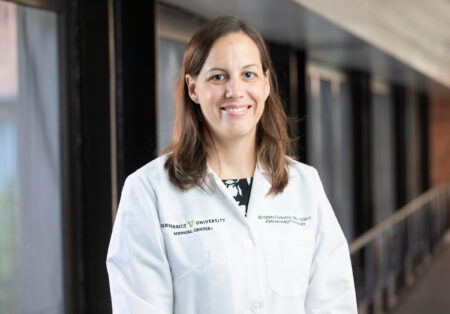
Kristen Ciombor, MD, MSCI (photo by Erin O. Smith)

Peek’s individual research program has been funded by the NIH for more than 30 years and includes R01 and P01 funding from the National Cancer Institute. He has been elected to the American Society for Clinical Investigation, the Association of American Physicians, the American Association for the Advancement of Science, the American Clinical and Climatological Association, and was a charter member of the NIH Gastrointestinal Mucosal Pathobiology Study Section.

He also served as chair of the American Gastroenterological Association (AGA) Council, co-editor-in-chief of Gastroenterology, as a member of the NIH National Institute of Diabetes and Digestive and Kidney Disease Advisory Council and was recently selected to be president President-Elect of the AGA World Gastroenterology Organization.

Ciombor is Associate Professor of Medicine in the Division of Hematology and Oncology at Vanderbilt, where she has been a faculty member since 2017. A board-certified medical oncologist specializing in gastrointestinal cancers, she leads multiple national investigator-initiated clinical trials in colorectal cancer. She is a co-investigator on the Vanderbilt-Ingram GI SPORE grant and leads the National Clinical Trials Network Lead Academic Participating Site grant at Vanderbilt. She also serves as chair of the Colorectal/Anal Working Group for the Eastern Cooperative Oncology Group and is a member of the NCI GI Steering Committee, among other roles.

“I am delighted that Dr. Peek has been selected to co-lead the Vanderbilt-Ingram GI Cancer Research Program,” Ciombor said. “He is a world-renowned gastroenterologist and expert in H. pylori pathogenesis and a true asset to the Vanderbilt research community. I am thrilled to work with him as we continue to strengthen the GI cancer research collaborations at Vanderbilt.”

“GI cancer incidence and mortality rates in our catchment area are worse than the national average, and screening for diseases like colorectal cancer also are lower in Tennessee than in many other states,” said Ben Ho Park, MD, PhD, the Benjamin F. Byrd Jr. Professor of Oncology and Director of Vanderbilt-Ingram. “GI cancers have been a long-standing priority of the Vanderbilt-Ingram Cancer Center, in part because of the burden of GI cancers in our area, but also because of the exceptional expertise here at Vanderbilt.

“Together, Drs. Peek and Ciombor bring deep knowledge and experience to optimize and personalize the prevention, diagnosis and treatment of GI malignancies. The GI cancer research program at Vanderbilt-Ingram will flourish under their strong co-leadership.”

The post Richard Peek joins Kristen Ciombor as Co-Leader of Gastrointestinal Cancer Research Program appeared first on Vanderbilt Health News.
A link between bacterial infection and colorectal cancer: study

Submitted by vicc_news on

Colorectal cancer is the second most common cause of cancer-related deaths worldwide, according to the World Health Organization. Understanding factors that contribute to the development of colorectal cancer could point to new targets for treating the disease at earlier stages, when survival rates are highest. 

Nicholas Markham, MD, PhD

Nicholas Markham, MD, PhD, assistant professor of Medicine, and colleagues are exploring how bacteria in the colon may contribute to cancer development. They previously showed that C. diff (Clostridioides difficile) isolated from human colorectal cancer samples accelerated tumorigenesis in the colon in a mouse model of intestinal cancer. 

Now, they have combined single-cell RNA sequencing, spatial transcriptomics and immunofluorescence to build a multiomic atlas of gene expression and protein abundance in C. diff-associated colorectal tumorigenesis. 

They report in The Journal of Pathology that the protein DMBT1 (Deleted in Malignant Brain Tumors 1) shows striking differences in regulation in areas of the colon with inflammation versus dysplasia (abnormal cellular changes). DMBT1 is a protein with roles in mucosal immune defense and epithelial cell differentiation. 

In a mouse model, the researchers found that expression of DMBT1 increases in normal absorptive colon cells exposed to C. diff, but that its expression is reduced in dysplastic areas compared to normal adjacent tissues. 

Immunofluorescence studies confirmed that DMBT1 protein was downregulated in dysplastic regions from three mouse models of colonic tumorigenesis and in colorectal precancerous adenomas from human samples. Using mouse and human organoids, the researchers implicated WNT signaling in the downregulation of DMBT1 mRNA and protein. 

The findings suggest that loss of DMBT1 could be a mechanistic link between bacterial infection and colorectal cancer development. Further studies will explore how DMBT1 might function to limit tumorigenesis. 

Emily Green, a graduate student in the Molecular Pathology and Immunology program, is the first author of the study. Collaborators at Johns Hopkins University School of Medicine contributed to the study. The research was supported by grants from the Department of Veterans Affairs (BX005699, BX002943) and the National Institutes of Health (P30DK058404, P30CA068485, R00CA230192, P50CA236733).

The post A link between bacterial infection and colorectal cancer: study appeared first on VUMC News.

Subscribe to Division_of_Gastroenterology_Hepatology_and_Nutrition