
This phase I trial evaluates the safety and effectiveness of using two imaging techniques, indium In 111 panitumumab (111In-panitumumab) with single photon emission computed tomography (SPECT)/computed tomography (CT) and panitumumab-IRDye800 fluorescence imaging during surgery (intraoperative), to detect disease in patients with head and neck cancer. 111In-panitumumab is an imaging agent made of a monoclonal antibody that has been labeled with a radioactive molecule called indium In 111. The agent targets and binds to receptors on tumor cells. This allows the cells to be visualized and assessed with SPECT/CT imaging techniques. SPECT is special type of CT scan in which a small amount of a radioactive drug is injected into a vein and a scanner is used to make detailed images of areas inside the body where the radioactive material is taken up by the cells. CT is an imaging technique for examining structures within the body by scanning them with x-rays and using a computer to construct a series of cross-sectional scans along a single axis. Panitumumab-IRDye800 is an imaging agent composed of panitumumab, a monoclonal antibody, linked to a fluorescent dye called IRDye800. Upon administration, panitumumab-IRDye800 targets and binds to receptors on tumor cells. This allows the tumor cells to be detected using fluorescence imaging during surgery. Adding 111In-panitumumab SPECT/CT imaging to intraoperative panitumumab-IRDye800 fluorescence imaging may be more effective at detecting disease in patients with head and neck cancer.
This phase III trial compares the effect of adding immunotherapy (brentuximab vedotin and nivolumab) to standard treatment (chemotherapy with or without radiation) to the standard treatment alone in improving survival in patients with stage I and II classical Hodgkin lymphoma. Brentuximab vedotin is in a class of medications called antibody-drug conjugates. It is made of a monoclonal antibody called brentuximab that is linked to a cytotoxic agent called vedotin. Brentuximab attaches to CD30 positive lymphoma cells in a targeted way and delivers vedotin to kill them. A monoclonal antibody is a type of protein that can bind to certain targets in the body, such as molecules that cause the body to make an immune response (antigens). Immunotherapy with monoclonal antibodies, such as nivolumab, may help the body's immune system attack the cancer, and may interfere with the ability of tumor cells to grow and spread. Chemotherapy drugs such as doxorubicin hydrochloride, bleomycin sulfate, vinblastine sulfate, dacarbazine, and procarbazine hydrochloride work in different ways to stop the growth of cancer cells, either by killing the cells, by stopping them from dividing, or by stopping them from spreading. Cyclophosphamide is in a class of medications called alkylating agents. It works by damaging the cell's deoxyribonucleic acid (DNA) and may kill cancer cells. It may also lower the body's immune response. Etoposide is in a class of medications known as podophyllotoxin derivatives. It blocks a certain enzyme needed for cell division and DNA repair and may kill cancer cells. Vincristine is in a class of medications called vinca alkaloids. It works by stopping cancer cells from growing and dividing and may kill them. Prednisone is in a class of medications called corticosteroids. It is used to reduce inflammation and lower the body's immune response to help lessen the side effects of chemotherapy drugs. Radiation therapy uses high energy x-rays to kill tumor cells and shrink tumors. Adding immunotherapy to the standard treatment of chemotherapy with or without radiation may increase survival and/or fewer short-term or long-term side effects in patients with classical Hodgkin lymphoma compared to the standard treatment alone.

Alex Cheng, Ph.D., M.S., M.E.M

  • Assistant Professor of Biomedical Informatics

Alex Cheng, Ph.D., M.S., M.E.M

  • Assistant Professor of Biomedical Informatics

a.cheng@vumc.org

Research Program

Research Description

Have any questions? Contact Us 1-877-936-8422 for more information

Lauren Corona, M.D.

  • Assistant Professor of Urology

Lauren Corona, M.D.

  • Assistant Professor of Urology

lauren.corona@vumc.org

Research Program

Research Description

Have any questions? Contact Us 1-877-936-8422 for more information

Ronald Alvarez elected president of American Gynecological and Obstetrical Society

Submitted by robbikm2 on

Ronald Alvarez, MD, MBA, the Betty and Lonnie S. Burnett Chair in Obstetrics and Gynecology, was recently elected the 42nd president of the American Gynecological and Obstetrical Society (AGOS), the most prestigious organization of leaders in obstetrics and gynecology in the nation.

Molecular Profiles of Tissue Plus Circulating Tumor DNA Can Better Guide Cancer Care

Submitted by robbikm2 on

The current standard of care for identifying targetable mutations in cancer treatment is to conduct molecular profiles on tumor tissue samples, but a study published Monday in JAMA Network Open authored by Wade Iams, MD, and colleagues indicates that adding liquid biopsy testing for circulating tumor DNA mutations increases targetable mutation detection rates.

Exceptional Growth for Amyloidosis Care

Submitted by robbikm2 on

When the Vanderbilt Amyloid Multidisciplinary Program (VAMP) launched in 2011, it was the first center in Tennessee dedicated to patients with amyloidosis – a rare, systemic disorder that encompasses myriad presentations and organ dysfunctions. Since then, VAMP has paved the way to coordinated care as a major referral center in the southeastern United States, growing to include over a dozen collaborating specialists working to provide structured, multidisciplinary care to adults navigating an amyloidosis diagnosis.
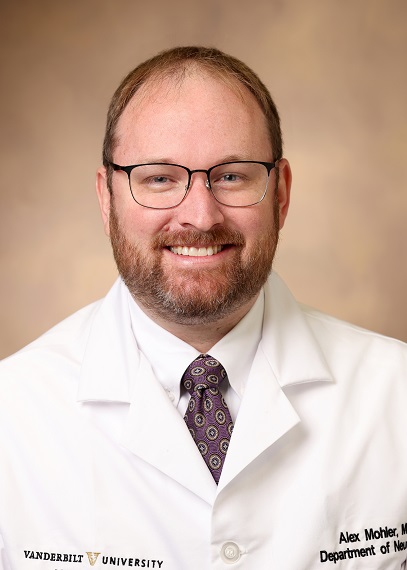
Alexander Mohler, M.D., M.S.

  • Assistant Professor of Neurology

Email

alexander.mohler@vumc.org
1301 Medical Center Dr

Alexander Mohler, M.D., M.S.

  • Assistant Professor of Neurology

alexander.mohler@vumc.org

1301 Medical Center Dr

Research Program

Research Description

Have any questions? Contact Us 1-877-936-8422 for more information

Nicholas Zachos, Ph.D., M.S.

  • Associate Professor of Surgery Research

Nicholas Zachos, Ph.D., M.S.

  • Associate Professor of Surgery Research

n.zachos@vumc.org

Research Program

Research Description

Have any questions? Contact Us 1-877-936-8422 for more information
Subscribe to

