
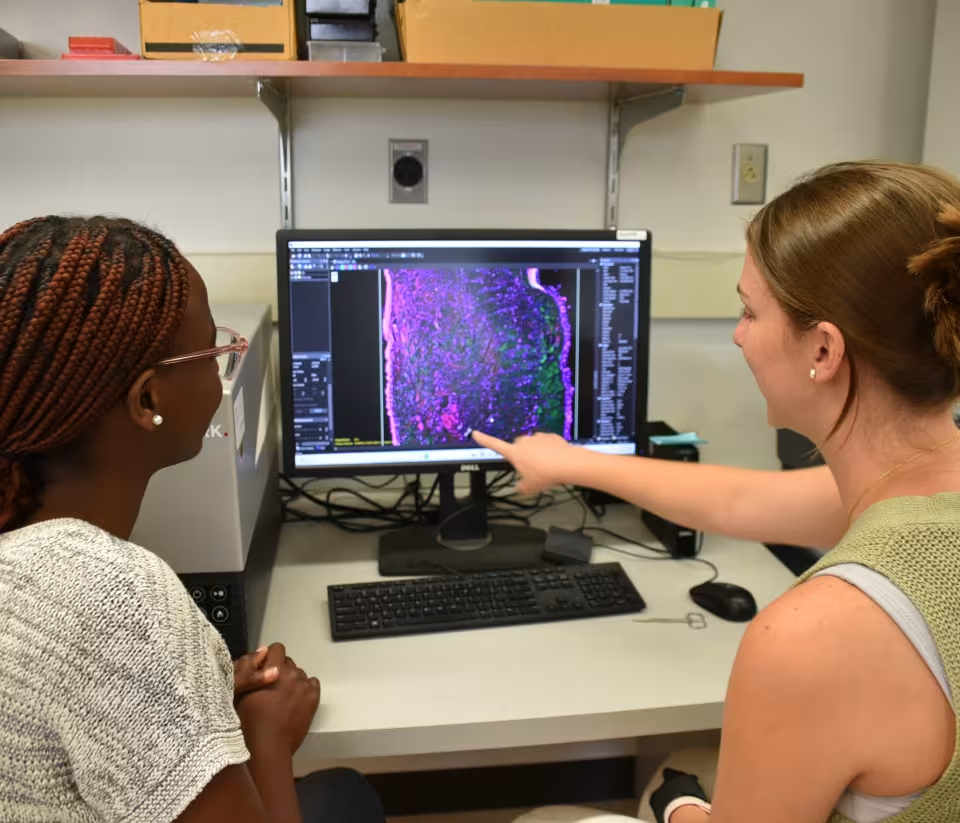
Cancer Cell Biology Research Program
Investigating cellular signaling pathways, metabolism, RNA regulation, this research program is dedicated to understanding key aspects of cancer cell biology, with the goal of therapeutically undermining the dysfunctional processes that lead to cancer and its metastasis.
Exploring Fundamental Biological Mechanisms Driving Cancer
The Cancer Cell Biology Research Program at Vanderbilt-Ingram Cancer Center is built upon strong interdisciplinary collaboration. The focus of this research program is on the biological mechanisms that lead to cancer as potential vulnerabilities to target for detection and treatment of disease. The program brings together expertise in cancer biology, computational science, artificial intelligence (AI), and drug discovery to develop an engine of discovery focused on developing new cutting-edge therapeutics or methods of precision medicine.
Research Themes
The Cancer Cell Biology Research Program can be organized into research themes:
Cancer-rewiring of Signaling Networks
Understanding the processes by which cancer hijacks normal cellular processes locking them into constantly active states. Examples of the signaling networks regularly co-opted in cancer include but are not limited to PI3K/AKT, MAPK/ERK, and Myc.
Metabolic Reprogramming
Discovering the processes where tumor cells change how nutrients are used to survive, grow more rapidly, and become resistant to therapy.
Cell Motility
Active movement and metastases of cancer is the primary driver of the lethality of cancer. Understanding how tumor cells move away from the primary tumor to invade through blood or lymphatic systems into other organs is important to determine opportunities to limit or prohibit metastasis.
RNA-Dependent Processes
Cancers can deregulate normal RNA mechanisms to promote growth and resistance to therapy. Understanding how splicing, chemical modifications, and translation changes lead to cancer will be vital in future therapeutic options.
Artificial Intelligence Research
Using AI tools to better understand structural biology and for drug design.
Meet the Program Members
The Cancer Cell Biology Research Program, co-led by Jin Chen, MD, PhD, and Katrin Karbstein, PhD, is an active group of more than 40 basic, translational, and clinical scientists whose goal is to understand how signaling networks control cell proliferation and function, to identify drug leads, and to develop new cancer therapeutics.

Jin Chen
Co-Leader, Cancer Cell Biology Research Program, VICC

Katrin Karbstein
Co-Leader, Cancer Cell Biology Research Program, VICC
Featured News
Training Tomorrow's Leaders
Monica Brown selected as 2026 Vanderbilt Prize Student Scholar
She will receive a $1,000 cash prize and will be mentored by the recipient of the 2026 Vanderbilt Prize in Biomedical Science, Eva Nogales, PhD, an internationally known…

Training Tomorrow's Leaders
New graduate students are urged to forge reputations ‘others can trust’
White lab coats symbolize academic rigor, scientific excellence and commitment to benefit society through research and discovery.
Genetics & Genomics
Vanderbilt Health and UAB partner to help more clinicians use genomic medicine in everyday care
The project, called the Southeast Genomic Medicine Service, or SE-GEMS, will create a genomic eConsult service that allows clinicians to ask practical questions about genetic…
A Selection of Recent Publications from our Cancer Cell Biology Members
JCI Insight
Identification of asporin as a HER3 ligand exposes a therapeutic vulnerability in prostate cancer
PLoS Biology
The kinase Rio1 and a ribosome collision-dependent decay pathway survey the integrity of 18S rRNA cleavage
Science Advances
Substrate displacement of CK1 C-termini regulates kinase specificity
Trends in Genetics
Advances in lasso peptide discovery, biosynthesis, and function
Nature Cell Biology
Blebbisomes are large, organelle-rich extracellular vesicles with cell-like properties
Science Signaling
Conditional requirement for dimerization of the membrane-binding module for BTK signaling in lymphocyte cell lines
Science Signalling
Autophosphorylation of oncoprotein TEL-ABL in myeloid and lymphoid cells confers resistance to the allosteric ABL inhibitor asciminib
Nature Communications
LassoESM a tailored language model for enhanced lasso peptide property prediction
Become a Research Member
Innovation and discovery are driven by collaboration. Becoming a member of Vanderbilt-Ingram Cancer Center extends your participation and opportunities to engage with peers to investigate the questions around how to best prevent, diagnose, treat, and manage cancer.